inTuition taster: A fresh approach
The diversity of teachers’ professional backgrounds is one of the great strengths of the FE and skills sector. Many have either come into the sector from industry or are working as dual professionals, so bring priceless experience and expertise.
But while many teaching staff do a great job for their learners without having completed initial teacher education (ITE), the argument for completing ITE has grown stronger in recent years. Now, the Department for Education (DfE) aims to strengthen the system, ensuring a strong supply of qualified teachers and improving the quality of training. Part of this has seen the Education Training Foundation (ETF), alongside a range of stakeholders, develop the Diploma in Teaching (DiT) for FE and skills framework.
Available since September 2024, DiT qualifications replace the Diploma in Education and Training and are aligned with the Learning and Skills Teacher Occupational Standard. They include Certificate in Education (CertEd); Level 6 Professional Graduate Certificate in Education (ProfGCE); Level 7 Postgraduate Certificate in Education (PGCE) and Postgraduate Diploma in Education (PGDE) awards. A spokesperson for the DfE claims that the link to the occupational standard means “the DiT better reflects the current needs of FE employers”.
All FE ITE qualifications must be based on the DiT framework guidance, which recommends a minimum of 360 guided learning hours, with teaching placements of at least 250 hours, including 150 hours of teaching practice (of which 100 hours must be in the trainee’s specialist subject). The framework states that sustainability, as well as equality, diversity and inclusion (EDI), should be featured throughout the programme as “embedded themes”.
Trainees should also attend two placement locations, spending at least 20 hours at the second placement. They must undergo 10 observations, a majority of which must involve teaching groups of at least 10 learners. There is a core unit on digital and online teaching, and the themes of sustainability and EDI are prominent throughout these.
ITE trainees must also be supported by two mentors, including a subject specialist, and should have weekly contact with both. Assessment methods include completion of a portfolio of evidence related to their placements and formal discussions about aspects of professional practice.
Mentor support
Mike Tyler MSET is a lecturer in ITE at the University of Worcester who also works closely with FE colleges delivering ITE in the surrounding region. He thinks the fact that trainees are encouraged to discuss their learning with their fellow trainees on the course as well as mentors is a useful feature of the new framework.
“We want to be sending out practitioners who are comfortable talking about their practices and identifying areas where they might improve,” he says. “There’s peer reflection as part of the assessments they do, and conversations with mentors.”
There is widespread approval for the suggestion that trainees have two mentors, including a subject specialist.
“In a sector with a recruitment crisis, where everyone’s got a heavy workload and increased stress, that support network is vital for early-career teachers,” says Lora Scott FSET ATS, curriculum lead for teacher education at Coventry College. But she also acknowledges practical challenges faced by both the mentors and mentee in establishing and maintaining these relationships.
“We worry that by placing two 30-minute meetings into every week, and the learners having to write this up, you’re putting an additional workload on these early-career teachers,” she says. “This can only work if it’s properly resourced and timetabled.”
There has also been a generally positive reaction to the requirement for a second placement location too, although that includes some welcoming that the second placement only needs to comprise 20 hours, doesn’t need to include teaching practice, and could even take place in the same college as the first placement.
“Whether ‘placement’ is the right word if you’re just popping along to a different department to watch a colleague, I don’t know,” says Tyler. “But getting trainees out of their bubbles is good.”
Scott says trainees and ITE teaching staff at both Coventry and Loughborough College benefit from the two colleges co-operating to offer trainees second placements in very different environments. She says collaborative work between the two providers is also enhancing development of CPD resources for ITE teachers. “This is a diverse sector and we should be collaborating and learning from each other,” says Scott.
ETF senior education advisor Nathan Rogan MSET QTLS agrees. “It’s always good to see those partnerships,” he says. “The best colleges and providers are those that work with others and aren’t afraid to reach out to improve best practice.”
Embracing innovation
It seems likely that many ITE teachers and trainees will welcome the opportunity to use different assessment methods to support inclusive and sustainable practices, including the professional discussion, which aligns well with the requirements of the Occupational Standard.
“This programme opens up the door to innovation in our assessment practices,” says Tammara Lindsay MSET, teaching, learning and assessment lead at Blackburn College. “We need to see more innovative assessment methods when training teachers.” The use of AI or other digital tools within ITE course assessment processes also mirrors the way trainees will use these technologies later when working as FE teachers and assessing some of the work of the learners they teach.
There have also been positive responses to the inclusion of digital pedagogy within the DiT framework, in part because developing these skills will help enable a broader range of alternative provision for learners, including for SEND learners.
At Burnley College, ITE trainees participated in a two-day conference on ‘Supporting SEND in a Digital World’ earlier this year, focusing on both these themes. The conference was created by ITE lecturer Sameeha Desai, to help trainees gain a better understanding of the roles digital technologies can play in this sector, and of the importance of planning inclusive lessons for all learners.
“It was a real success,” says Desai. “I’m looking at organising it again for the next cohort.” Future conferences will involve more collaborations with other colleges that also work closely with the University of Greater Manchester (Bolton) on ITE for FE and skills.
As well as colleges and universities, other education and training providers are also using the new ITE framework and Occupational Standard. SCL Education Group programme lead Amber Orr says the company used the launch of the framework as an opportunity to overhaul its provision, and that the needs of SEND learners, or other people facing some sort of learning barrier, are central to its new offer.
She says positive results of this change are already visible in trainee feedback: “Trainees say they don’t only get a good understanding of supporting learners with SEND – they also understand how to create a good environment for all learners.”
How does it feel to complete ITE today? Tendai White MSET has just finished a PGCE Post 14 ITE course at the University of Derby and says it has been a hugely positive experience. White has trained to become a business studies teacher following a successful career in business. She says she always had the idea she might work as a teacher at the back of her mind, but decided to change career after the death of a younger relative, who had almost escaped a troubled youth thanks to the work of teachers who helped him while he was in prison.
She found the ITE course challenging, in part simply because it had been a long time since she was last in full-time education. But with the support of her ITE teachers, she was able to succeed. “I grew a lot in confidence during the course, and I think a big part of that was because of the teachers,” she says. “It was pushing us out of our comfort zones. They gave us that confidence that we could do it.”
She thinks one of the most important aspects of the course is the way it encourages trainees to reflect carefully on their own performance. “You’re trained to reflect on ‘What went well?’, ‘What didn’t go well?’ and ‘What can I do better next time?’” White explains. “I think it’s helped to shape me as a teacher.”
Future developments
During the next few years, we are likely to see further evolution of ITE, as it continues to be a priority for policymakers. “Our focus is on quality and standards, including identifying and disseminating some of the excellent practice that already exists across the sector,” says the DfE spokesperson.
“We’re expecting to introduce new regulations under the 2022 Skills Act. Subject to parliamentary approval, these will require FE ITE providers to have regard to new guidance on delivery and curriculum standards, and will require providers to register with DfE and provide information on courses and students. We see this as vital step towards better management of the provider market, bringing greater consistency and clarity for trainees and employers.”
At Coventry, Scott says they intend to make further improvements in relation to specialist subject teaching: at present there may not always be enough depth of provision available in every setting for every subject, simply because there are so many subjects.
“As a small provider, our delivery team will not have the expertise to deliver subject-specific pedagogy to all the subjects that FE and skills cater for,” she says. “We don’t know what industries our future cohorts will specialise in and this can vary from year to year.” She believes that increased collaboration with other providers may help, but planning and facilitating support for every subject is likely to continue to be a challenge.
Another theme is the need to keep adding to support networks for early-career teachers. The DfE spokesperson says it is keen to support this: “Programmes such as Taking Teaching Further and our Teacher Mentoring Programme already provide wraparound support for teachers starting their careers. We want to think further about how we can make the right support accessible to all new teachers coming into the sector, ensuring this becomes part of a career-long journey of professional development.”
So, while these are still early days, at present the message seems to be: so far, so good. ITE is now providing a solid grounding for early-career teachers, preparing them to work with learners and priming them for the step-up to Qualified Teacher Learning and Skills (QTLS) status. “It’s definitely a much better course,” says Desai. “It’s more relatable for the learners coming through our doors. I love teaching on it!”
For Lindsay, it is the combination of practical experience and reflective elements that offers the greatest positive change, enabling trainees to combine their subject-specific expertise with all the skills and knowledge they will need to succeed.
“I think the programme really reflects reality,” she says. “It is supported by a strong foundation of teaching, learning and assessment theory, but is driven by real-world experience and reflective practice. I feel confident that our trainees are better prepared for the challenging landscape of the FE and skills sector.”
David Adams is a freelance journalist with a strong background in education
Views expressed are those of the author and do not necessarily reflect those of SET.
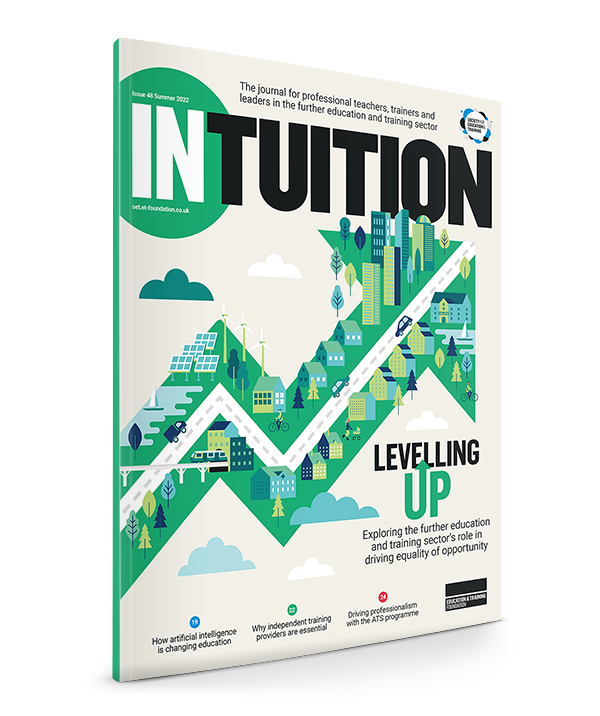
Find out more about inTuition
inTuition is SET’s quarterly professional magazine supporting members' access to CPD resources and the latest sector and research news. It combines sector news with educational research and exciting practical developments and ideas in education and training.
Find out more