inTuition taster: Art, craft
The current debate about how best to teach in the further education (FE) and skills sector centres around competing perspectives on the fundamental nature of teaching. The three main contrasting viewpoints consider teaching to be either a science, an art or a craft, with a fourth considering that elements from different perspectives might co-exist to inform effective practice.
While exact definitions may be hard to pin down, the different concepts represent important tensions in the sector. Teaching as an art tends to emphasise creative, intuitive and personal dimensions of education and draws on the unique personality and style of teachers. Teaching as a craft positions education as a skilled practice developed through experience, apprenticeship and the gradual mastery of techniques.
Teaching as science, meanwhile, argues that effective education is grounded in empirical research and evidence-based practices. It emphasises the importance of cognitive science, data-driven decision-making and the application of research-proven methodologies.
Science
The Education Endowment Foundation (EEF) is an independent charity that generates and mobilises evidence to help schools and colleges break the link between family income and educational attainment. Kathryn Davies is 16-19 lead at the EEF, flying the flag for an evidence-informed approach to teaching in the FE and skills sector.
“Teachers are not disempowered by science and evidence,” she says. “It is a way of strengthening professional judgement and teachers welcome this opportunity to enhance their practice. In FE and skills, industry expertise is invaluable, but you still need a good pedagogical approach and the evidence base for that is still developing.”
The EEF does randomised controlled trials in many FE and skills settings across the regions. “We don’t ever dictate ‘what works’ but we do offer ‘best bets’-based evidence, which gives teachers a basis for developing their own practice in their context,” Davies explains.
For the EEF, the scientific approach to teaching in FE and skills offers additional insights to help the teaching process, not to replace the input of teachers. “A science perspective on teaching and learning is a combination of factors. There is no silver bullet,” Davies says. “Teachers still need to think about the results of a trial and how to apply it in their specific circumstances with their learners. We are talking about an evidence base for FE and skills and that feels very positive. We are keen for the whole sector to get involved.”
David Russell MSET, senior director of UK public policy at Pearson, suggests that a craft model may be a better ‘best fit’ description of teaching, while acknowledging that science can provide a theory for understanding why things happen as they do. “If teaching is a science, then obviously it’s an applied science,” he says. “Teachers might say: ‘What does the science tell me will happen if I do this? What will the outcome be if I do that?’”
For Russell, teaching is uncontroversially a science in part. “It’s just a science that we haven’t got to the bottom of yet,” he said. “Teaching is about human interactions and they are so incredibly complex that science is only ever going to be approximate. It’s like a fractal geometry picture where you see the pattern, but then zoom in on it and the pattern becomes more complex. The science of teaching can give you an overall pattern when you zoom right out. But the more you zoom into the detail, the more complex it gets. You can never zoom into a level of granularity where it resolves and stops becoming more complex.”
Artistry
Maggie Gregson, professor of vocational education at the University of Sunderland, points out that the whole of education is a classroom experiment. “Teachers are always trying to create the best educational opportunities they can for their learners in the light of experience and evidence from their practice,” she says.
“The idea of ‘what works’ is problematic because it underestimates the importance of context, and closes down spaces in which the teacher can operate as researcher and artist. Creative curriculum design and good educational practice are not detached or mechanistic activities but artistic endeavours involving systematic and context-attuned research.”
Imran Mir FSET QTLS, campus head and programme lead at Apex College Leicester, considers the scientific perspective to be vital, but cautions about allowing teaching to become overly mechanistic. “Data can guide us, but it cannot replace the human side of education,” he says.
This view is shared by Jade Clay, apprenticeship industry trainer and advanced teaching practitioner. “Using evidence and research helps us improve outcomes and make informed choices,” she explains. “But teaching isn’t just data; it’s also about relationships, motivation and context. A purely scientific approach can miss the human side. We need to use evidence wisely, without losing the richness of interaction.”
For Ruth Kendrick MSET, group director of teaching and learning at New City College in London, really good teachers are creative, empathetic, responsive and flexible. “They are all incredibly important aspects in teaching,” she says.
Similarly, Russell emphasises that teaching is a human interaction, but learning doesn’t have to be. “There’s something about the scientific lens and the scientific method, which is deliberately unhuman or dehumanised, and that’s part of its strength and its power,” he suggests.
Craft
The contrast between teaching as a craft and as an art offers some wisdom for the sector, believes Russell. “I think art eschews consistency for creativity,” he says. “I’d say consistency is almost the defining characteristic of a craft and I would reject any suggestion that only science brings consistency.
“One of the big differences between science and craft is not the absence or presence of consistency; it’s the absence or presence of theorisation. When you get consistency in a science, you understand why it’s consistent. The craftsperson may not fully understand why they get the results they get; they can just do it. Craft privileges practice over theory, but theory isn’t irrelevant. A craftsperson needs to have some understanding of what will help their practice, but it’s not the dominant thing.”
Clay echoes these sentiments. She feels teaching as a craft values experience, judgement and hands-on knowledge – this is vital in FE, especially in vocational areas. “It helps us make smart decisions in real time. But it can also risk sticking to ‘how things have always been done’. To stay current, we need to combine craft with reflection, collaboration and openness to new ideas.”
The craft model resonates strongly with Mir’s work in vocational and business programmes. “Much of what I do involves mentoring staff and drawing on the tacit knowledge that comes only through experience,” he explains. “When guiding students through concepts like balance sheets or cash flow, I often use real-world business examples; a practical craft-like approach that makes abstract ideas tangible.”
Blended approach
The debate finds a conclusion in the belief that teaching in the FE and skills sector is a mix of science, art and craft and that this is core to professional identity. “Whichever way we view teaching – as an art, a craft or a science – in practice we use a synthesis of all three,” Kendrick says. “Some people think taking a science perspective makes you more mechanistic, but the science gives you an essential foundational knowledge as a basis for a blended approach to teaching. It is essentially a toolkit, but needs to be applied with knowledge of students and with finesse.”
This view is shared by Russell, who feels that judicious application of science is key, while tempered with intuition built over a long time of craft. “In the classroom,” he says, “I won’t use that as a rule book as if it was the guidance for mixing sodium hydroxide and calcium carbonate. I will apply it as a background rubric, which I then decide when to enforce, let go or emphasise. The craftsperson has informed practice rather than dictated practice.”
For Mir, different contexts within FE and skills call for different balances. “Apprenticeships often depend on the craft model,” Mir explains. “Adult education thrives when teachers bring artistry and flexibility. Academic and vocational programmes benefit from a mix of craft and science. The most effective practitioners can shift fluidly between these approaches depending on the learners and the context.”
“Evidence-informed teaching is more prevalent in some curriculum areas,” Kendrick adds. “Our English and maths directorates have worked hard on incorporating an evidence base in their work and consequently have seen a rise in attainment. In construction, we are exploring ways of boosting learning through an evidence-based approach to support the art and craft style of delivery of the subject.”
Gavin Lumsden MSET QTLS, teacher educator at Essential Teaching UK, agrees. “Teaching is an art, a craft and a science. A good teacher is the one who can blend all three. We need more storytelling, more creativity and more links to practice. That is the art form. It is teaching as artistry. You cannot be a successful teacher if all you have is theoretical knowledge.
“How can we perform as teachers with presence and connection? That is an art. The skills are lesson plans, assessment, behaviour management, curriculum design and so on. These are all needed. But if you don’t have the artistry to turn theory into practice, your knowledge is wasted.”
For Gregson, too, the teacher in FE and skills should be regarded as teacher, researcher or artist. “Teachers need to know how they have constructed their own epistemic architectures,” she says. “You need creativity to do that. It is a complex practice but so important for making sense of their subject. They know that others make sense of things differently, but human experience connects us.”
“Teaching is at its strongest when art, craft and science work together,” Mir concludes. He feels that these three ways of conceptualising teaching also shape teacher identity. “As artists, teachers value creativity and autonomy,” he says. “As craftspeople, they take pride in mastery and practical wisdom. As scientists, they commit to rigour and accountability. In my experience, effective professionalism comes from blending these perspectives, knowing when to improvise, draw on experience and lean on research and evidence.”
Do you see teaching as an art, craft or a science, or a combination of these? Visit the link to vote now.
Elizabeth Holmes is a freelance journalist specialising in the education sector.
Views expressed are those of the author and do not necessarily reflect those of SET.
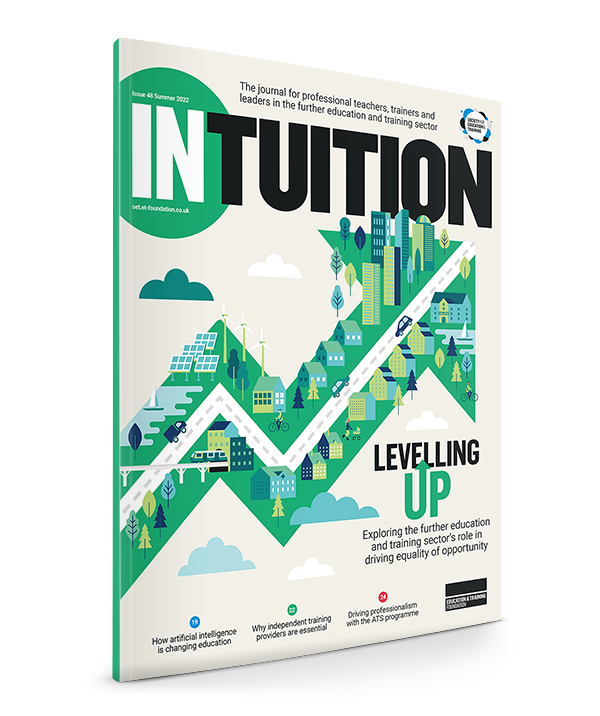
Find out more about inTuition
inTuition is SET’s quarterly professional magazine supporting members' access to CPD resources and the latest sector and research news. It combines sector news with educational research and exciting practical developments and ideas in education and training.
Find out more